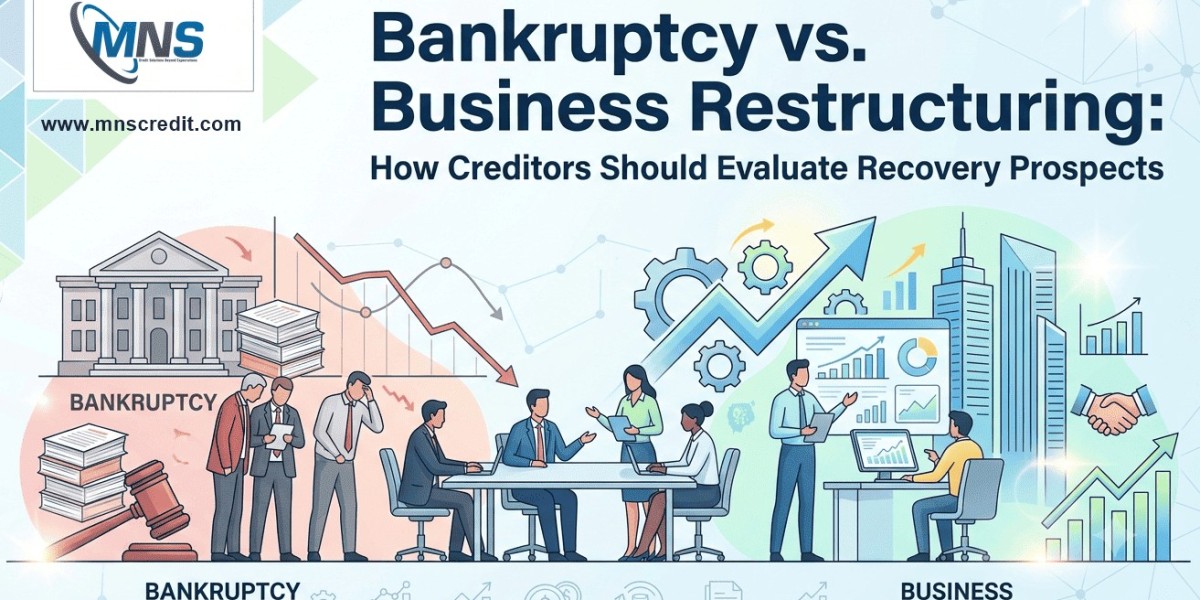

When a customer or borrower runs into financial distress, creditors are often asked to make a consequential decision under time pressure: support a restructuring or resolution plan that keeps the business alive in some form, or push toward liquidation and accept whatever the asset break-up value delivers. The two paths lead to very different recovery outcomes, timelines, and risks, and creditors who understand the trade-offs are far better placed to vote and negotiate in their own interest.
Two Fundamentally Different Paths
Liquidation is, in essence, a value-destroying process. The company stops operating as a going concern, its assets are sold — often at distressed prices — and the proceeds are distributed to creditors strictly according to the statutory priority waterfall. Restructuring, by contrast, aims to preserve the business as an operating entity, either through a negotiated resolution plan under the Corporate Insolvency Resolution Process (CIRP), a scheme of arrangement under the Companies Act, or an out-of-court restructuring negotiated directly with lenders and major creditors. The central premise of restructuring is that a business kept alive, with revised debt terms, new capital, or a change in ownership, is usually worth more to its creditors collectively than the same business broken up and sold for parts.
Why Restructuring Usually Offers Better Recovery — But Not Always
Going-concern value typically exceeds liquidation value because it captures the worth of customer relationships, trained employees, supply contracts, brand, and operating licenses that are lost or heavily discounted the moment a business shuts down. This is the economic logic behind India's shift, through the IBC, toward resolution as the preferred outcome over liquidation. However, restructuring is not automatically better for every creditor in every case. A resolution plan can still offer creditors less than they expect if:
• The incoming resolution applicant prices significant execution or turnaround risk into their offer
• Existing promoters or a new acquirer negotiate aggressive haircuts as a condition of taking the business on
• The plan defers payment over several years, exposing creditors to further execution risk during implementation
• Operational creditors are treated as a lower priority class within the plan, receiving a smaller proportion of their claim than financial creditors
The correct comparison a creditor should make is never "restructuring versus doing nothing" — it is "the value offered under this specific plan versus the value realistically achievable through liquidation of this specific company."
How to Evaluate a Resolution or Restructuring Plan
Creditors evaluating a proposed plan, whether inside a formal CIRP or an out-of-court restructuring, should scrutinise several elements before deciding whether to support it:
Liquidation value versus plan value: The IBC requires that no creditor receive less under an approved resolution plan than they would receive in liquidation. Creditors are entitled to review the liquidation value estimate prepared by registered valuers and should question assumptions that seem optimistic about asset recoverability or unrealistically low about going-concern value.
Payment timeline and certainty: An offer of 40% recovery paid in 90 days is often more valuable in practice than an offer of 60% recovery spread over five years with conditions attached, once time value of money and execution risk are factored in.
Treatment relative to other creditor classes: Creditors should compare their proposed recovery percentage against that offered to other classes. Significant disparities, particularly where operational creditors receive markedly less than financial creditors for reasons not clearly justified by security or statutory priority, are grounds for objection before the NCLT.
Feasibility and viability of the plan: A resolution plan must demonstrate that the acquirer or existing management has the operational capability and funding to execute the turnaround. Plans reliant on speculative future fundraising, unproven management teams, or aggressive revenue assumptions carry a higher risk of failure even after approval.
Monitoring and enforcement mechanisms: Well-structured plans include monitoring committees, milestone-linked disbursements, and clear consequences for default during implementation. The absence of these mechanisms increases the risk that an approved plan under-delivers relative to its stated terms.
Creditor Decision-Making in Practice
Financial creditors sitting on the Committee of Creditors vote directly on resolution plans and can negotiate terms before approval. Operational creditors and other stakeholders without a CoC vote still retain the right to raise objections before the NCLT if a plan appears to violate the minimum liquidation-value guarantee or unfairly discriminates against their class. In out-of-court restructurings, where no statutory floor applies, creditors have even greater need to independently model both scenarios — restructuring cash flows under the proposed new terms versus an estimated recovery in a formal insolvency filing — before agreeing to any waiver, standstill, or extended repayment schedule.
Building the Capability to Assess These Trade-Offs
Making this comparison well requires access to reliable information: updated financial statements, an independent view of asset values, litigation and charge records, and a realistic assessment of the proposed management team's track record. Businesses that maintain ongoing credit intelligence on major counterparties, rather than starting due diligence only after a distress event is announced, are able to move faster and negotiate from a position of knowledge rather than reacting under pressure to whatever plan is placed in front of them.
Out-of-Court Restructuring Versus Formal Insolvency
Not every restructuring happens inside a formal insolvency process. Many companies approach lenders and major creditors directly for a standstill agreement, revised repayment schedule, or debt-for-equity conversion before any filing is made, often through frameworks such as the Reserve Bank of India's prudential framework for resolution of stressed assets. Out-of-court restructuring can preserve more value than a formal CIRP by avoiding the reputational damage, operational disruption, and professional fees associated with tribunal-supervised proceedings, and it typically moves faster. The trade-off is that creditors lose the statutory protections built into the IBC, including the minimum liquidation-value guarantee and the structured claims process. Creditors negotiating an out-of-court restructuring should insist on the same rigour they would apply inside a formal process: independent verification of the company's financial position, clear milestones tied to any concessions granted, and a credible fallback plan if the restructuring fails to deliver as promised.
Red Flags That a Restructuring Plan May Underperform
Certain warning signs recur across restructuring plans that ultimately fail to deliver the promised recovery. These include repeated requests for further concessions shortly after a previous restructuring was agreed, management teams unwilling to share detailed operational and cash flow projections supporting the plan, funding commitments from investors that remain conditional or undocumented at the time creditors are asked to vote, and previous restructuring or refinancing attempts with the same counterparty that failed to resolve the underlying distress. Creditors who have seen one restructuring plan already underperform should treat a second proposal from the same management team with proportionately greater scepticism and demand stronger enforcement mechanisms before extending further concessions.
Conclusion
Bankruptcy and restructuring are not simply "bad" and "good" outcomes — they are two different mechanisms for realising value from a distressed business, each with distinct risks for creditors. The right decision depends entirely on the specific numbers: the credible liquidation value of the company, the realism of the plan's assumptions, the payment timeline, and how the creditor's own claim is treated relative to other stakeholders. Creditors who insist on rigorous, independent evaluation of these factors — rather than accepting management's or an insolvency professional's framing at face value — consistently achieve better recovery outcomes, whichever path the company ultimately takes.