
Introduction
The State Pollution Control Board (SPCB) is a state regulatory body for environment which controls and prevents pollution generated by industries, commercial units, and other activities. According to the type of activity carried out by the business, there might be a requirement for approval from authorities to start a unit. The certificate/ NOC from SPCB usually indicates that the business entity has obtained environmental clearance from the concerned state body. This will assist the business in complying with requirements regarding air pollution, water pollution, and waste management. Knowledge about the functions of the State Pollution Control Board and the process of obtaining clearance will be helpful for the business.
State Pollution Control Board – Definition
The State Pollution Control Board is the body that implements the environmental and pollution control policies in their respective states. While the process and portals may differ in different states, SPCB normally controls the activities that can result in air pollution, wastewater, hazardous waste, solid waste, etc.
The board can consider the following points for assessing an industrial/commercial unit:
- The type of business activity carried out
- The pollution capacity of the proposed facility
- The location of the facility
- The water usage and wastewater generation
- The air emissions and use of fuel
- The waste generation and disposal process
- The pollution-control machinery and proposed safeguards
According to these criteria, the appropriate permits are decided upon.
SPCB Certificate & SPCB NOC - What Do They Refer To?
The terms 'SPCB Certificate' and 'SPCB NOC' are generally used in connection with the approvals related to pollution control. The document issued by the authority depends upon various factors such as state, category of industry, and project phase.
Consent to Establish
For setting up some industries/facilities, the requirement of Consent to Establish (CTE) exists. The approval revolves around whether the project can be established in compliance with pollution control norms.
Consent to Operate
Once the establishment of requisite infrastructures and pollution control systems takes place, the requirement of Consent to Operate (CTO) arises for operating the units. Hence, companies cannot generalize the requirement of any approval. The precise requirement can be determined from the concerned State Pollution Control Board.
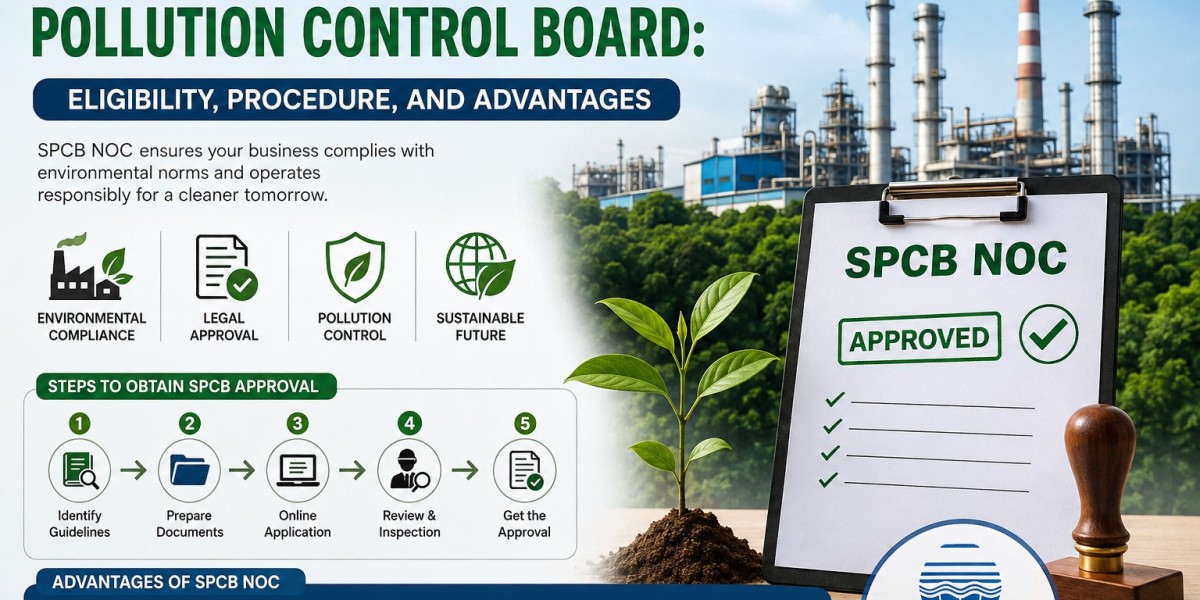
Steps to Obtain SPCB Approval
Application procedure varies statewise, but normally, the steps involved are as follows:
1. Identification of Relevant Guidelines
The first step would be to understand what category your business falls into and whether it qualifies for CTE, CTO, waste permission, or any other type of approval.
2. Preparation of Necessary Documentation
Documentation required by various organizations might include business registration, ownership/lease papers, layout plans, project reports, manufacturing/process description, water and power requirement, pollution control details, and waste management information.
3. Filing an Online Application
SPCBs normally have online facilities to register yourself, fill the form, upload documents, and pay the relevant charges.
4. Review and Inspection
The authority may review the submitted information, if necessary, conduct a site inspection to confirm the infrastructure and pollution control measures of the project.
5. Get the Approval
In case all the requirements are met, the authority may grant the corresponding consent or permission, subject to certain conditions.
Considerations for Businesses
Getting an SPCB NOC does not mean that the environmental compliance process ends for the business. The business should strictly adhere to the conditions indicated in its permission. Any changes in production capacity, raw material used, manufacturing process, fuel usage, location, pollution control system and other aspects of the business activity may need prior approval or modification of the consent already obtained. The business should keep track of renewal period and also maintain records of waste management and other environmental considerations.
Common Questions Concerning State Pollution Control Boards
1. What is the role of State Pollution Control Board?
The role of State Pollution Control Board is to control and monitor pollution related activities in the state jurisdictions. It helps in enforcing the environmental laws and lays down the conditions required for the industries and other regulated activities.
2. What does SPCB Certificate mean?
SPCB Certificate means a generic term used for environmental permission issued by State Pollution Control Board. It varies according to the nature of activity and state regulations.
3. Is SPCB NOC necessary for all kinds of business activities?
No, not necessarily. It depends on the nature of the activity, size and pollution capacity of the activity among other things.
4. What is the difference between CTE and CTO?
CTE means consent to establish while CTO means consent to operate.
5. Is an SPCB approval amendable later on?
Yes, in case there is a need for it. In cases where an establishment has undergone major alterations in terms of operations, capacity, process, and pollution generation, it might have to go for amendment, expansion, and other types of permits.
Conclusion
The State Pollution Control Board holds considerable importance in making sure that industrial and business activities follow the environmental guidelines. It is essential to know if SPCB certificate, SPCB NOC, consent to establish, consent to operate, or any other type of permission is needed. As there could be variations in the process of application and other documents from one state to another, it is necessary to confirm the requirement from the respective State Pollution Control Board.